
ROICA
Return on Intangible Capital Allocation — the discipline of setting, measuring, and enforcing hurdle rates on intangible investments to enhance ability to compound over the long-term
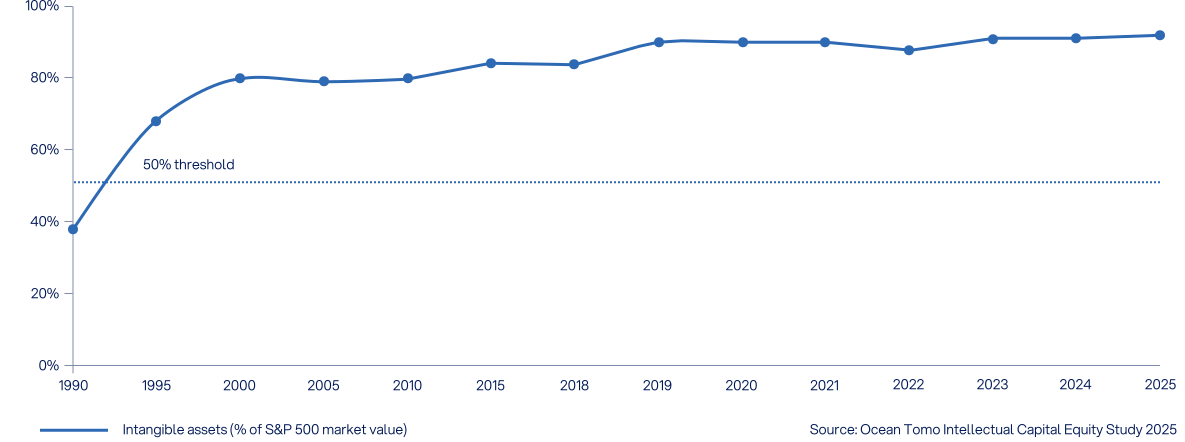
Intangible assets have grown from 38% to 92% of S&P 500 market value since 1990 — the fastest structural shift in the history of capital markets.
ROICA
Return on Intangible Capital Allocation — the discipline of setting, measuring, and enforcing hurdle rates on the three categories of intangible investment that compound or erode technology company value over time. Boards and management teams that adopt this framework build structurally more durable businesses.
The capital allocation problem
Technology companies report their income statements as if R&D, sales & marketing, and acquisition goodwill are consumption — not investments to be underwritten. Without disiplined underwriting, returns on these investments gradually deteriorate, and inhibit long-term value-creation.
How ROICA reframes the question
ROIC is an ineffective way to assess long-term value creation on intangible asset allocation. While the cost is reflected immediately, the benefit comes over time. Investments in product development and customer acquisition take years to recoup. ROICA is our internal metric that evaluates a Company’s return rate (e.g., Customer IRR) on their respective investments, with an emphasis on high return investments that can generate long-term, internal compounding.
Each intangible investment category has a distinct return profile, a measurable payback horizon, and a set of leading indicators that signal whether capital is compounding or eroding.


The companies that sustain ROIC above WACC for the longest period generate the highest total shareholder returns. The empirical record is unambiguous.
McKinsey’s 40-year ROIC study found that companies with ROICs above 20% had a 50% probability of remaining in that quintile for a decade — a persistence rate that dwarfs growth, which is fleeting in virtually every cohort studied.
What drives that persistence? Not product superiority alone — competitors close product gaps. Not market position alone — TAMs saturate. The companies that sustain high ROIC do so because they have institutionalised capital allocation discipline: they know what their S&M investment is returning, they know which R&D programmes are building the moat, and they have a clear-eyed framework for when M&A creates versus destroys value. This is precisely what 2717 Partners brings to its portfolio companies — an emphasis on measuring what matters — with a long-term time-horizon.
When 2717 Partners engages on intangible capital allocation, we arrive with a rigid analytical framework and a roadmap for implementing ROICA governance that creates measurable value within 12–18 months.
Assess the historical capital allocation results, identify the areas for improvement, and establish frameworks to measure what matters
Reconstruct the intangible capital base — capitalising historical R&D, S&M, and M&A expenditure — and calculate true ROICA for each category. Identify which investments are generating ROIC above WACC and which are destroying capital silently.
Establish ROICA targets and align incentives at an organizational level
Implement ROICA hurdle rates for each category, creating attribution frameworks that connect S&M and R&D spend on both a short-term and long-term basis. Align incentive structures, top-down, that create durable value for all stakeholders, including customers, employees, and shareholders.
Redirect capital from low-return investments to high-return ones
Redirect capital from low-return intangible investments to high-return ones — concentrating R&D on retention-focused improvements and near-term “build” expansion opportunities, optimizing S&M towards highest return segments, and defining a disciplined M&A program with a clearly defined cross-sell thesis. The outcome, systematically applied, is a company that earns a high return on capital investment, and creates a pathway to long-term value creation.